Contributions may come through hundi collections, cash, UPI, bank transfers, cheques, online payments, seva bookings, festival sponsorships, or special-purpose funds. If these records are not maintained clearly, temple committees may face confusion during reporting, auditing, or trustee meetings.
Transparency is not only about showing numbers. It is about building trust with devotees. When people know that their contributions are recorded, acknowledged, and used responsibly, they feel more connected to the temple.
1. Maintain Proper Donation Records
The first step towards transparent donation management is accurate record keeping. Every donation, whether small or large, should be recorded with basic details such as donor name, date, amount, mode of payment, purpose, receipt number, and remarks if required.
For example, a donation received for annadanam should be recorded separately from a general donation or a renovation contribution. This helps the temple understand how much money has been received for each purpose and how it should be used.
Paper registers may work for a small number of entries, but they become difficult to manage as the volume increases. A digital donation register helps avoid duplicate entries, missing records, unclear handwriting, and manual calculation mistakes.
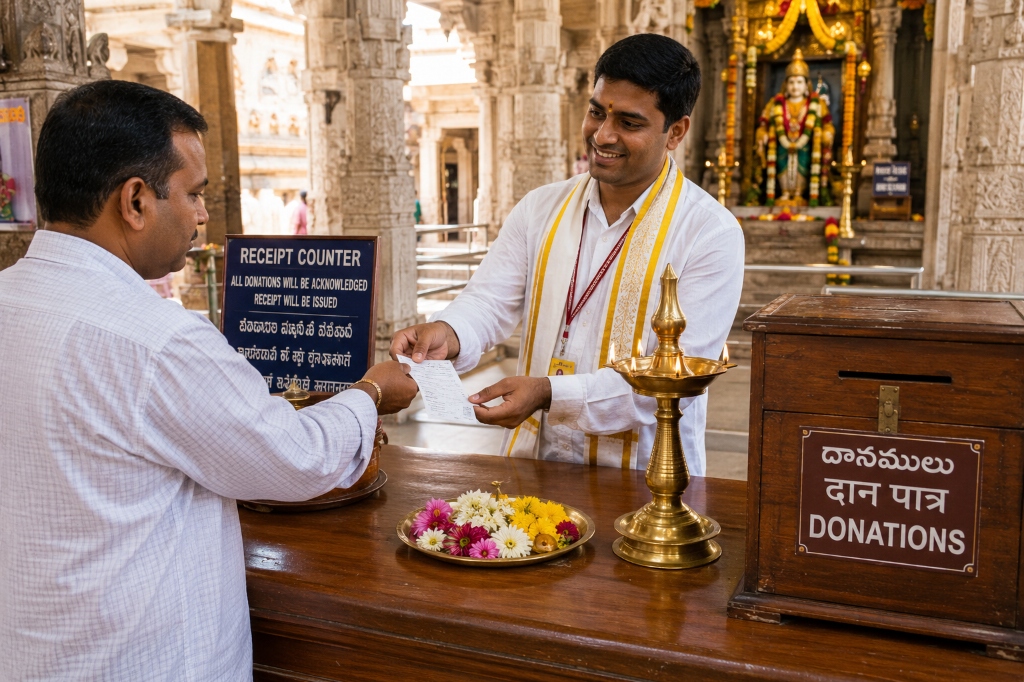
Devotee receiving a printed receipt at a traditional temple donation counter, ensuring transparency and trust.
2. Issue Receipts for Every Donation
A receipt is more than a formality. It is an acknowledgement of trust.
Temples should issue receipts for all donations, whether the contribution is made in cash, through UPI, bank transfer, cheque, or online payment. The receipt should clearly mention the donation amount, date, purpose, donor name if available, and receipt number.
Receipts also make future verification easier. If a devotee asks for confirmation or if the accounts team needs to reconcile collections, proper receipt records save time and reduce disputes.
Digital receipts can make this process even smoother. They can be generated quickly, shared through email or WhatsApp, and stored for future reference.
3. Separate Donations by Purpose
Not all donations are the same. Some are general offerings. Some are meant for a specific seva. Some are given for annadanam, festival sponsorship, temple renovation, education support, goshala service, or other charitable work.
When donations are grouped properly, trustees get a clearer view of available funds. It also prevents confusion between general funds and purpose-specific contributions.
For example, if devotees contribute specifically for a renovation project, those funds should be tracked separately. This allows the temple to report how much was collected, how much was spent, and what work was completed.
This kind of clarity builds confidence among devotees and committee members.
4. Reconcile Cash, Bank, and Digital Payments Regularly
Today, temples receive donations through many channels. Cash collections may come from the counter or hundi. Digital payments may come through UPI QR codes. Bank transfers may come from devotees living in other cities or countries.
Because of this, regular reconciliation is essential.
Temple teams should compare receipt records with cash collections, bank statements, UPI settlements, and online payment reports. This should be done daily for busy temples and at least weekly for smaller temples.
Regular reconciliation helps identify missing entries, payment failures, duplicate records, and pending deposits. It also makes monthly accounting and annual audits much easier.
5. Share Periodic Reports with Trustees
Trustees and committee members should not have to wait until the end of the year to understand donation activity. Monthly or quarterly reports can provide a simple summary of collections and usage.
A useful donation report may include:
- Total donations received
- Donations by payment mode
- Donations by purpose
- Major donor contributions
- Seva-linked donations
- Festival collections
- Expenses made from specific funds
- Balance available for planned activities
These reports help trustees take better decisions and maintain responsible oversight.
6. Communicate Fund Usage to Devotees
Transparency improves when temples communicate how donations are being used. This does not mean publishing every internal accounting detail. It means sharing meaningful updates with devotees.
For example, a temple may share that annadanam donations helped serve meals to a certain number of devotees, or that renovation contributions supported painting, flooring, electrical work, or gopuram maintenance.
Simple updates on notice boards, websites, newsletters, or WhatsApp groups can make devotees feel involved. When people see the impact of their contribution, they are more likely to support future temple activities.
7. Use Digital Tools for Better Control
Manual records can become difficult to manage as the temple grows. A temple management application like MandirMitra can help bring donation records, receipts, devotee details, seva bookings, expenses, and reports into one organized system.
With a digital system, temple administrators can quickly search donation history, generate receipts, track payment modes, prepare trustee reports, and maintain better accountability.
This does not replace the traditional values of the temple. It simply strengthens the administration behind those values.
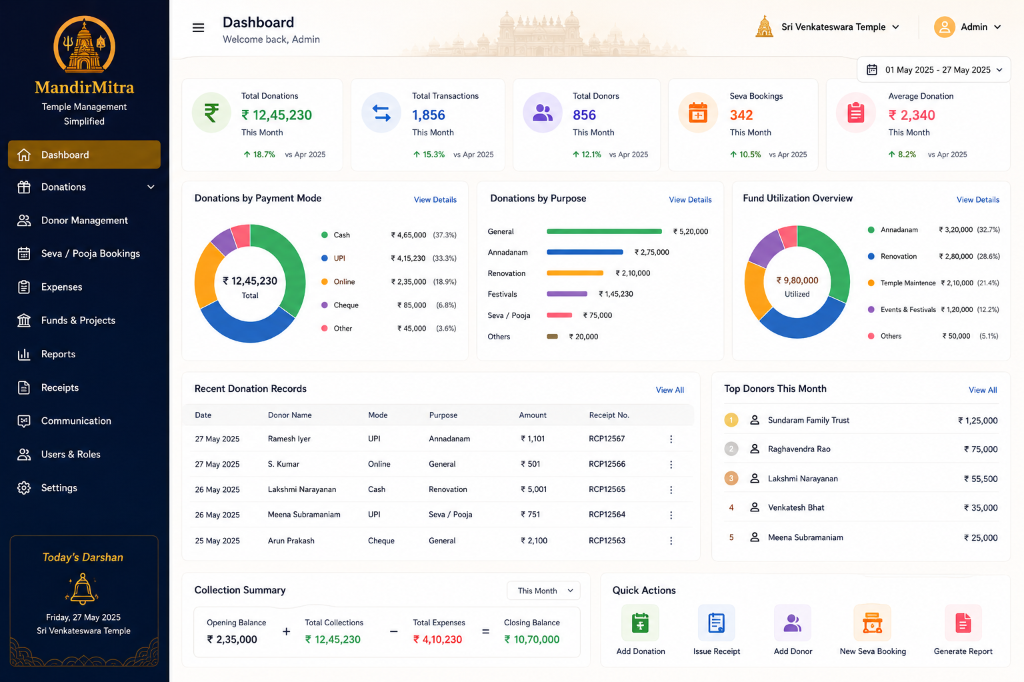
MandirMitra temple management dashboard showing donation summary, payment modes, and fund utilization reports.
8. Create a Culture of Financial Discipline
Transparency is not only a software feature or an accounting process. It is a culture.
Temple staff, volunteers, priests, trustees, and administrators should follow clear rules for accepting, recording, depositing, and reporting donations. Responsibilities should be defined. Cash handling should be controlled. Receipts should be mandatory. Reports should be reviewed regularly.
When everyone follows the same process, transparency becomes part of the temple’s identity.
Conclusion
Temple donations are given with devotion and faith. Managing them with care is a responsibility.
By maintaining proper records, issuing receipts, separating donations by purpose, reconciling payments regularly, and sharing meaningful reports, temples can build stronger trust with devotees and trustees.
Digital tools like MandirMitra can make this process simpler, faster, and more reliable. They help temples move from scattered records to organized management, from manual follow-ups to clear reporting, and from uncertainty to transparency.
A transparent temple is not only better managed. It is better trusted.
Better records. Better accountability. Greater devotee trust.