For many housing societies, collecting maintenance on time remains a regular challenge. Bills are prepared manually, reminders are sent on WhatsApp, payment details are checked one by one, and committee members spend hours following up with residents.
The issue is usually not unwillingness to pay. In many cases, the problem is lack of clarity, delay in communication, limited payment options, and manual tracking. Digital maintenance billing can change this completely. It brings structure, speed, and transparency to the entire collection process.
1. The Problem with Manual Maintenance Billing
Many housing societies still depend on spreadsheets, paper registers, handwritten receipts, and informal WhatsApp reminders. This may work when the society is small, but it becomes difficult as the number of flats increases.
Manual billing often leads to delayed bill generation, calculation mistakes, missed reminders, unclear payment status, and confusion over pending dues. A resident may say they have already paid. The treasurer may need to check bank entries, UPI screenshots, receipt books, and old messages before confirming it.
This creates unnecessary stress for both residents and committee members. When the process is manual, collections become inconsistent. Some residents pay immediately, some pay only after reminders, and some dues remain pending simply because follow-up is not systematic.
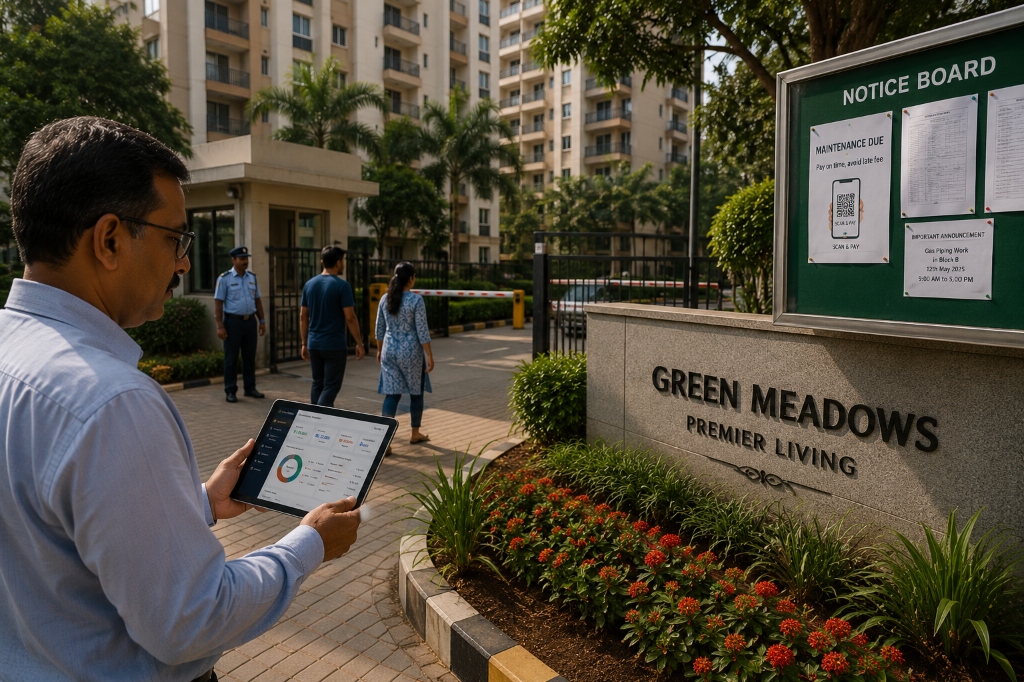
A committee member reviewing maintenance records on a tablet at a modern apartment housing society entrance, promoting digitized administration.
2. Bills Are Generated on Time
Timely billing is the first step towards better collections. With digital maintenance billing, societies can generate monthly, quarterly, or annual maintenance bills in a consistent format. Charges can be calculated based on flat size, fixed monthly amount, parking charges, water charges, sinking fund, repair fund, penalties, or any other society-specific rule.
This reduces the risk of manual errors. It also ensures that every resident receives the bill at the same time with clear details. When bills are delayed, payments are delayed. When bills are sent on time, residents are more likely to pay on time.
3. Residents Get Clear Payment Details
A common reason for delayed payment is lack of clarity. Residents may not know the exact amount payable, due date, previous balance, late fee, or payment method. Digital billing solves this by giving each resident a clear bill with all required details in one place. The bill can show the current month’s charges, previous outstanding amount, due date, payment link, and receipt status.
This reduces back-and-forth communication. Instead of asking, “How much should I pay?” or “Has my previous payment been adjusted?”, residents can check the bill directly.
4. Automated Reminders Improve Collection Discipline
Manual reminders are one of the most time-consuming tasks for society committees. Sending individual messages, checking who has paid, and following up again can become frustrating. Digital systems can automate reminders before and after the due date. Residents can receive reminders through email, SMS, WhatsApp, or app notifications depending on the system being used.
This makes follow-up more polite, consistent, and professional. Automated reminders also remove personal discomfort. Committee members do not have to repeatedly chase neighbours for payments. The system handles the reminder process, while the committee can focus on governance and service quality.
5. Multiple Payment Options Make It Easier to Pay
Collections improve when payment becomes convenient. Many residents prefer UPI. Some prefer net banking. Others may use cards or bank transfers. A digital billing system can support multiple payment options and make the process faster for residents.
When payment links are included directly in the bill, residents can pay immediately instead of postponing it. The easier the payment process, the higher the chances of timely collection.
6. Receipts and Payment Records Are Updated Faster
In manual systems, even after a resident pays, the treasurer may need to verify the payment and update the records later. This delay can cause confusion. Digital maintenance billing helps maintain payment records more efficiently. Once payment is confirmed, receipts can be generated and shared with residents. The society committee can also view paid, pending, and overdue bills from one dashboard.
This gives everyone better visibility. Residents get confidence that their payment has been recorded. Committee members get a clear picture of collections without searching through multiple files or messages.
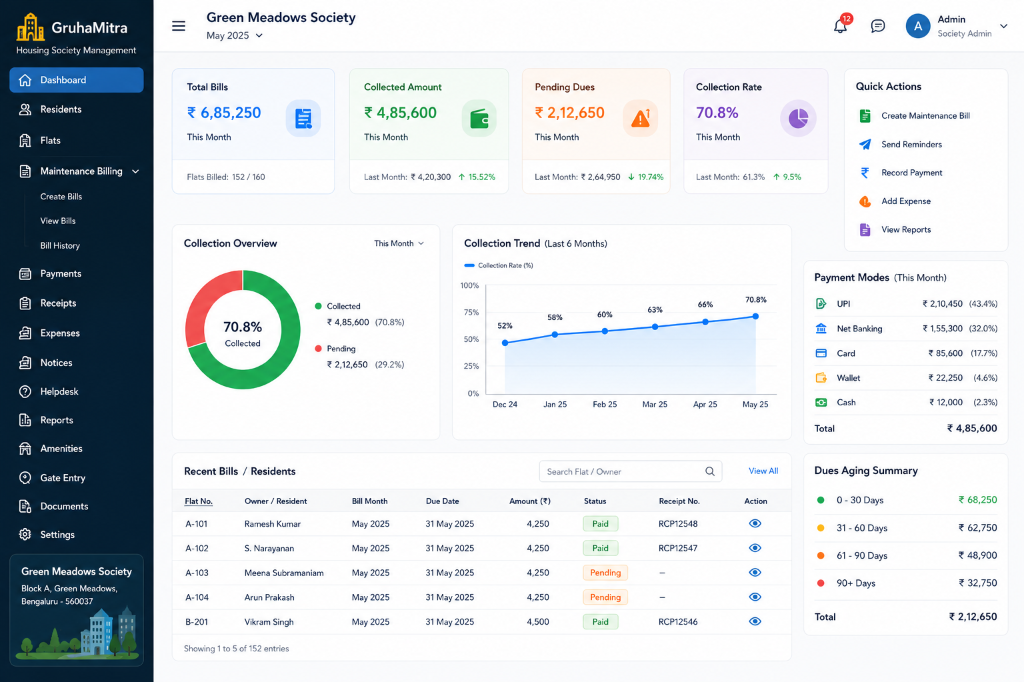
GruhaMitra housing society billing dashboard showing total bills, collected amount, pending dues, and aging summary.
7. Pending Dues Become Easier to Track
One of the biggest advantages of digital billing is the ability to track pending dues accurately. The committee can see which flats have paid, which are pending, how long dues have been outstanding, and how much amount is overdue. Reports can be filtered by month, flat number, owner, tenant, block, or payment status.
This helps the committee take timely action. Instead of discovering large pending dues at the end of the year, societies can monitor collections every month and follow up early.
8. Better Reports Help Better Decision-Making
Housing societies need accurate financial reports to plan expenses. Security salaries, housekeeping contracts, repairs, AMC renewals, water tanker expenses, lift maintenance, and common area electricity all depend on regular collections.
Digital billing provides reports that help committees understand cash flow clearly. They can review total billed amount, collected amount, pending dues, collection percentage, and month-wise trends. This helps societies prepare budgets, avoid cash shortages, and make better decisions during committee meetings.
9. Transparency Builds Resident Trust
Residents are more willing to pay on time when they trust the system. Digital maintenance billing improves transparency by giving residents access to their bills, receipts, payment history, and outstanding dues. When records are clear, disputes reduce.
It also helps the committee demonstrate that billing is consistent and fair. Every resident receives the same level of clarity. Every payment is recorded. Every pending amount is visible. This creates a healthier relationship between residents and the managing committee.
10. A More Professional Way to Run the Society
A housing society is not just a residential building. It is a shared community with shared responsibilities. Digital billing brings professionalism to society management. It reduces manual effort, improves accountability, saves time, and helps committee members manage collections with less stress.
Applications like GruhaMitra can help housing societies organize billing, payments, receipts, resident records, expenses, and reports in one place. This makes day-to-day administration smoother and more reliable.
Conclusion
Digital maintenance billing is not only about sending bills online. It is about improving discipline, transparency, and efficiency in housing society collections.
When bills are generated on time, reminders are automated, payments are easy, receipts are clear, and reports are accurate, societies collect faster and operate better. For residents, it means convenience and clarity. For committees, it means less manual work and better control. For the society as a whole, it means stronger financial management.
A well-managed society starts with a well-managed billing system.