Many business owners realize the importance of documentation only when there is a problem: a bank asks for records, an investor starts due diligence, a customer delays payment, a vendor disputes terms, an employee raises a claim, or a department asks for compliance proof.
Good documentation is not just for large companies. Startups, small businesses, professional firms, traders, service providers, LLPs, partnerships, and private limited companies all need organized legal records.
This article explains the common legal documents every Indian business should maintain and why they matter.
1. Business Registration Documents
The first set of documents every business should keep safely is its registration and constitution documents. These prove that the business legally exists.
For a private limited company, this includes the Certificate of Incorporation, Memorandum of Association, Articles of Association, PAN, TAN, and company master data records. For an LLP, it includes the Certificate of Incorporation and LLP Agreement. For a partnership firm, it includes the Partnership Deed and registration certificate, if registered. For a proprietorship, records may include GST registration, Shops and Establishment registration, Udyam registration, trade licence, PAN, and bank account documents.
These documents are often required for opening bank accounts, applying for loans, onboarding large customers, participating in tenders, signing contracts, and completing vendor registration.

A professional business desk with organized folders for incorporation, agreements, licences, and tax records.
2. PAN, TAN, GST, and Tax Registrations
Tax registrations are essential for business operations. A business should maintain copies of its PAN, TAN, GST registration certificate, professional tax registration where applicable, and any other tax-related registrations relevant to its activity.
PAN is needed for tax filing and financial transactions. TAN is required if the business deducts TDS. GST registration is required for businesses covered under GST law or those that voluntarily register. These documents are commonly requested by customers, banks, auditors, government departments, and online marketplaces.
It is also important to maintain updated login credentials, registration amendments, branch details, additional place of business records, and authorized signatory details.
A common mistake is keeping only the registration certificate but not tracking changes. If the business changes address, partner, director, signatory, trade name, or business activity, the supporting documents and registrations should be updated.
3. Licences and Permits
Different businesses need different licences. A restaurant, factory, consultancy, software company, clinic, educational institution, trading business, and housing project will not have the same compliance requirements.
Common licences and permits may include Shops and Establishment registration, trade licence, FSSAI licence, factory licence, labour law registrations, import-export code, fire safety approval, pollution control approval, drug licence, professional tax registration, and sector-specific permissions.
These documents should be stored in one place with issue date, renewal date, authority name, licence number, and renewal responsibility.
Many businesses face penalties not because they never obtained a licence, but because they failed to renew it on time.
4. Founder, Partner, or Shareholder Agreements
Every business with more than one owner should maintain a clear internal agreement.
For a partnership, this is usually the Partnership Deed. For an LLP, it is the LLP Agreement. For startups and companies with multiple shareholders, a Shareholders’ Agreement or Founders’ Agreement is highly useful.
These documents define ownership, capital contribution, profit sharing, responsibilities, voting rights, exit terms, transfer restrictions, dispute resolution, confidentiality, and decision-making authority.
When relationships are good, people often avoid formal documentation. But if there is disagreement later, unclear terms can damage the business.
A well-drafted agreement prevents confusion and protects both the business and its owners.
5. Board Resolutions and Meeting Records
Companies and LLPs should maintain proper records of important decisions. This includes board resolutions, shareholder resolutions, meeting notices, attendance records, minutes of meetings, and consent letters where required.
These documents are useful when the business opens bank accounts, appoints directors, authorizes signatories, takes loans, issues shares, changes registered office, approves contracts, or makes major business decisions.
For private limited companies, meeting records are especially important because they support corporate governance and ROC compliance.
A decision may be valid internally, but without documentation it can become difficult to prove later.
6. Statutory Registers and Company Records
Companies are required to maintain statutory records such as registers of members, directors, key managerial personnel, charges, share transfers, investments, loans, contracts, and other records depending on the nature of the company.
These registers are not just formalities. They provide a structured history of the company’s ownership, management, financial commitments, and key transactions.
During due diligence, funding, acquisition, audit, or legal review, statutory registers are often checked carefully.
Small companies sometimes ignore these records because day-to-day business feels more urgent. But poor statutory record-keeping can create serious issues when the company grows or seeks investment.
7. Customer and Vendor Contracts
Every business should maintain written contracts with important customers and vendors. These may include service agreements, supply agreements, purchase orders, work orders, engagement letters, subscription agreements, distribution agreements, and master service agreements.
A proper contract should clearly mention scope of work, price, payment terms, delivery timelines, responsibilities, warranties, termination rights, confidentiality, limitation of liability, dispute resolution, and governing law.
Without a written contract, the business may struggle to recover payments, prove agreed terms, or defend itself in case of disputes.
Even if the business uses simple quotations or purchase orders, they should include basic terms and conditions.
8. Employment and HR Documents
Businesses with employees should maintain proper employment records. These may include offer letters, appointment letters, employment agreements, salary structure, attendance records, leave records, confidentiality agreements, non-disclosure agreements, HR policies, resignation letters, relieving letters, and full-and-final settlement records.
For key employees, it is useful to include clauses on confidentiality, intellectual property, notice period, non-solicitation, company assets, data security, and code of conduct.
Employment documents reduce disputes and make HR processes more professional.
They are also useful during labour compliance checks, employee claims, client audits, and internal reviews.
9. Intellectual Property Documents
Many businesses create valuable intellectual property without realizing it. This may include brand names, logos, software code, website content, product designs, training material, marketing content, client presentations, proprietary processes, and databases.
Businesses should maintain trademark application records, copyright records where applicable, IP assignment agreements, designer/developer agreements, software development contracts, and brand usage permissions.
A common mistake is assuming that payment to a freelancer or agency automatically transfers ownership. In many cases, ownership should be clearly assigned through written terms.
If your business depends on a brand, software, content, product design, or technology, IP documentation is essential.
10. Financial, Accounting, and Tax Records
Legal documentation also includes financial and tax records. Businesses should maintain books of account, invoices, receipts, purchase bills, expense vouchers, bank statements, GST returns, TDS returns, income tax returns, audit reports, financial statements, and payment proofs.
These records support compliance, taxation, loans, audits, investor review, and dispute resolution.
For GST-registered businesses, invoices, credit notes, debit notes, payment vouchers, delivery challans, and related records should be maintained properly. For companies, books of account and financial papers are part of statutory compliance.
The safest approach is to maintain both digital and properly backed-up records.
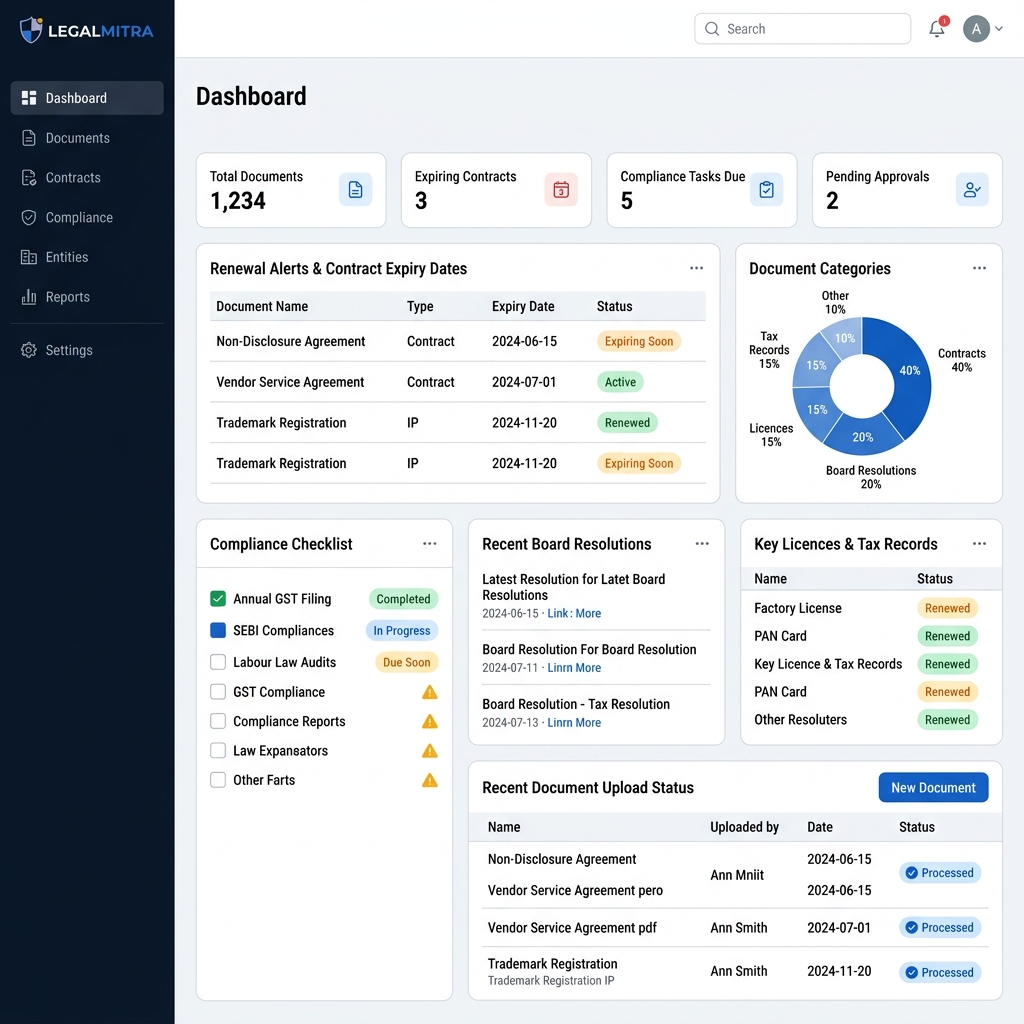
A clean LegalMitra legal document management dashboard showing document categories, renewal alerts, and compliance checklist.
11. Data Protection and Confidentiality Documents
As businesses become more digital, data protection and confidentiality documents are increasingly important.
Businesses should maintain privacy policies, website terms, customer consent records, employee confidentiality agreements, vendor NDAs, data processing terms, and internal access-control policies.
This is especially important for businesses that handle customer data, financial information, employee records, health information, legal documents, or software platforms.
Even small businesses should have basic confidentiality and data-handling rules.
12. Insurance and Risk Documents
Insurance records are often ignored until a claim arises. Businesses should maintain copies of policies such as fire insurance, office insurance, professional indemnity insurance, cyber insurance, employee insurance, vehicle insurance, stock insurance, and directors and officers insurance where relevant.
The business should also track policy numbers, coverage amounts, exclusions, renewal dates, premium receipts, and claim correspondence.
These documents are important for risk management and business continuity.
13. Notices, Disputes, and Legal Correspondence
Every business should preserve important legal correspondence. This includes legal notices, replies, demand letters, settlement agreements, arbitration records, court filings, police complaints, consumer complaints, and regulatory communications.
Even if a dispute is resolved informally, the records should be stored properly. They may be needed later if the issue reopens or if the business faces a related claim.
A simple folder for legal correspondence can save a lot of time during future reviews.
14. A Practical Document Management Habit
Maintaining legal documents is not only about collecting papers. It is about creating a system.
Every business should classify documents by category, store digital copies, restrict access to sensitive files, track renewal dates, maintain version history, and review records at least once every quarter.
Applications like LegalMitra can help businesses organize legal documents, track compliance deadlines, manage agreements, store licences, and keep important records accessible when needed.
For business owners, this means less confusion. For advisors, it means faster review. For investors, banks, and customers, it shows discipline and credibility.
Quick Checklist of Documents to Maintain
Every Indian business should consider maintaining:
- Incorporation or registration documents
- PAN, TAN, GST, and tax registrations
- Licences and permits
- Partnership, LLP, founder, or shareholder agreements
- Board resolutions and meeting minutes
- Statutory registers
- Customer and vendor contracts
- Employment and HR documents
- Intellectual property records
- Books of account and tax records
- Data protection and confidentiality documents
- Insurance policies
- Legal notices and dispute records
- Renewal and compliance tracker
Conclusion
Legal documents are not just files to be stored after registration. They are the foundation of a well-managed business.
Proper documentation helps a business prove its identity, protect its rights, comply with the law, manage relationships, handle disputes, and grow with confidence.
Whether you are running a startup, small business, LLP, partnership firm, or private limited company, maintaining the right legal documents is a habit worth building early.
Good documentation does not make business complicated. It makes business safer, clearer, and more professional.